
General
Illinois population: 12.7 million people, and only 18 counties still growing
Illinois had 12,719,141 residents in 2025, down about 93,000 since the 2020 census. Cook County is shrinking while Kendall County, southwest of Chicago, grew 10 percent.

OpenAI agents accessed Census and SEC websites in activity the company is now reviewing
OpenAI is reviewing what it calls misaligned model activity after its agents accessed public Census Bureau and SEC data. The company says it found no use of credentials and no access to nonpublic information.

Hispanic population by state: California leads, New Mexico is nearly half Hispanic
The U.S. has 64.8 million Hispanic residents, 19.3 percent of the population. California, Texas, and Florida hold more than half, and the fastest growth since 2010 has been in North Dakota and Tennessee.

How the census has counted race since 1790, and the 2030 plan to stop
Every census since 1790 has recorded race, but the groups on the form have changed decade by decade. Mexican was a race for one census, people chose their own race only from 1960, and multiple races arrived in 2000.

New Orleans demographics: two decades after Katrina
New Orleans had 362,154 residents in 2025, about 135,000 fewer than in 1990. The city is majority Black, more educated than ever, and still has one in five homes vacant.

Senator Elizabeth Warren demands Commerce explain why it dropped its ban on political interference in census data
Sen. Elizabeth Warren wants Commerce Secretary Howard Lutnick to explain why the department removed, without announcement, 'protection from inappropriate influence' from the scientific integrity policy covering the Census Bureau.
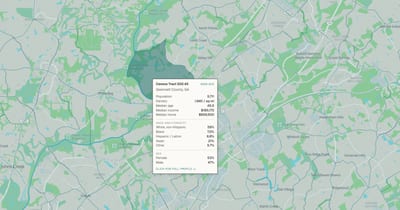
How many census tracts are in the US? 84,401, and here is how they are drawn
The 50 states and DC are divided into 84,401 census tracts, each meant to hold about 4,000 people. California has the most, Wyoming the fewest, and one Texas tract has 44,364 residents.

Census survey shows no change in child uninsured rate as Medicaid rolls shrink, but researchers say the data may be missing the real story
The Census Bureau's survey found 5.8 percent of children uninsured all of 2025, statistically unchanged. Georgetown researchers point to 2.5 million fewer children on Medicaid and CHIP and a missing state-level release.

The most and least diverse states in America, and how much every state changed since 1990
Two random Hawaiians differ in race or ethnicity 89.7 percent of the time. In Vermont it is 23.5 percent. Every state in the country grew more diverse since 1990, Nevada most of all.

Workers with a license or certificate earn 16% more, and high school grads gain the most
Full-time workers with a nondegree credential reported 16.4 percent higher median earnings, a Census Bureau study found. High school graduates with both a certificate and a license earned about 21 percent more.

Where Do the Most Salvadoran Americans Live?
The Census Bureau counts 2,583,416 people of Salvadoran origin, the largest Central American group. California leads, but the Washington, DC area is the surprise second center, a legacy of 1980s refugee migration.

What share of the US population was born in another country?
The United States had 50.2 million foreign-born residents in 2024, 14.8 percent of the population. The share ranges from 27.6 percent in California to 2.1 percent in West Virginia.

The US cities where people actually take transit to work
About 3.2% of American workers commute by public transportation. New York is at 44.0%, and every city in the top twelve sits on a rail network built before 1980. No Sun Belt city makes the list.

How Americans actually get health insurance
54.8% are covered through an employer, 20.9% by Medicaid, 18.4% by Medicare, and 8.4% not at all. The eight most uninsured large counties in the country are all in Texas.

Trump's plan to exclude some immigrants from the census could cost Texas and Florida House seats
A New York Times analysis finds removing noncitizens without green cards would shift seats from Texas and Florida to Minnesota and Oregon. Our own projection shows why: those states sit right at the cutoff.

The census has counted noncitizens since 1790, and the Trump administration wants to stop
Every census since the first one has included noncitizens in the count that divides up House seats. The 2030 proposal would break that rule, after a century of attempts that never changed the count.

What is a metropolitan area? How the Census draws the lines around 95% of Americans
A metro area is a group of whole counties tied together by commuting. There are 387 of them plus 538 micropolitan areas, covering 1,844 counties and 323.8 million people.

US retail sales jumped 1.2% in August as spending strengthened across nearly every category
Americans spent $773.9 billion at stores and restaurants in August, the strongest month of 2026. Online sellers are closing on car dealers, and grocery sales are barely moving.

Where the most Russian Americans live, from Brooklyn to Burleigh County
About 2.2 million Americans report Russian ancestry, a sixth of them in metro New York. North Dakota has the highest share of any state, and a Florida beach town the highest of any town.

How popular is the name Karen? Karen fell 60% after it became a meme
There are 880,756 living Karens, the 10th most common name among American women. Only 175 girls got the name in 2025. Compared with Cynthia, Brenda, and Linda, Karen's recent decline stands out.

US poverty rate fell to 10.2% in 2025, and child poverty hit a record low
The official poverty rate dropped for a third straight year to 10.2 percent, with record lows for children and Hispanic Americans. The broader Supplemental Poverty Measure held at 13.1 percent.