Who Gets the US Census?
See more of our coverage in your search results.
The short answer is everyone. The US Census is designed to count every single person living in the United States - regardless of age, citizenship status, immigration status, race, or income. But the full answer involves some important distinctions about who counts where, which groups are historically undercounted, and a current political debate about whether that "everyone" rule should change for the 2030 Census.
Every person, not every citizen
This is the part that surprises many people. The US Census counts all residents, not just citizens or legal permanent residents. According to the Urban Institute, the Constitution's 14th Amendment explicitly mandates that the census count "the whole number of persons in each State" - not the whole number of citizens. That language has governed census methodology since Reconstruction, and it means that undocumented immigrants, foreign students, temporary visa holders, and asylum seekers are all supposed to be counted at whatever address they live at on Census Day.
According to CBS News, the Census Bureau counts everyone living in the US regardless of their race or citizenship status. This matters enormously for congressional apportionment and federal funding - states with large immigrant populations, like California, Texas, and Florida, receive more congressional seats and federal dollars because of their total resident population, not their citizen population alone.
Where you get counted: the residence rule
The Census Bureau counts people at their "usual residence" - the place where they live and sleep most of the time. According to the Population Reference Bureau, this creates some specific rules for edge cases:
College students who live away from home are counted at their campus address, not their parents' home. Students who live at home and commute are counted at home. Foreign students attending college in the US are counted at their campus or off-campus residence. Children in split households are counted at the address where they spend most of their time. Newborns are counted even if they are still in the hospital on April 1 - Census Day. People in shelters are counted at the shelter. People incarcerated in prisons or correctional facilities are counted at the prison's address, not their home address. This last point - prison gerrymandering - has been a source of ongoing political controversy, since it counts inmates in the often-rural districts where prisons are located rather than the urban districts where most inmates come from.
People experiencing homelessness are counted too, though with obvious challenges. According to the Census Bureau, the 2020 Census sent 14,000 workers to campgrounds, RV parks, hotels, and marinas specifically to count people without permanent addresses.
US territories are included
The Census counts the population in all 50 states, the District of Columbia, and five US territories: Puerto Rico, American Samoa, the Commonwealth of the Northern Mariana Islands, Guam, and the US Virgin Islands, according to the Nevada Department of Administration. Territory residents are counted but do not have voting representation in Congress and are not included in the apportionment count that determines congressional seats.
Who gets left out
US citizens living abroad are generally not counted, with one major exception. According to The Fulcrum, military personnel and civilian employees of the US government stationed overseas are counted at their home state address for apportionment purposes. Private citizens living abroad - retirees, digital nomads, expats - are not counted at all in the decennial Census.
Despite the goal of counting everyone, some groups are consistently undercounted. According to the Texas State Demographer, the populations historically missed at disproportionately higher rates include children under 5, people of color, renters, larger households, single-parent households, immigrants, and low-income populations. According to the US Government Accountability Office, the 2020 Census had significant coverage errors in 14 states, with young children and minorities continuing to be the hardest groups to count.
The 2030 debate: should noncitizens be excluded?
The question of who gets counted is not settled for the 2030 Census. According to NPR, President Trump has indicated he wants the 2030 Census to exclude noncitizens from the count used for congressional apportionment. According to the Urban Institute, removing unauthorized immigrants from the count would have the largest impact on California, Florida, and Texas - the three states with the most undocumented residents - which could each lose congressional seats as a result. Whether this is constitutionally permissible given the 14th Amendment's "whole number of persons" language is a question that will likely end up before the courts before 2030.
What questions does the census actually ask
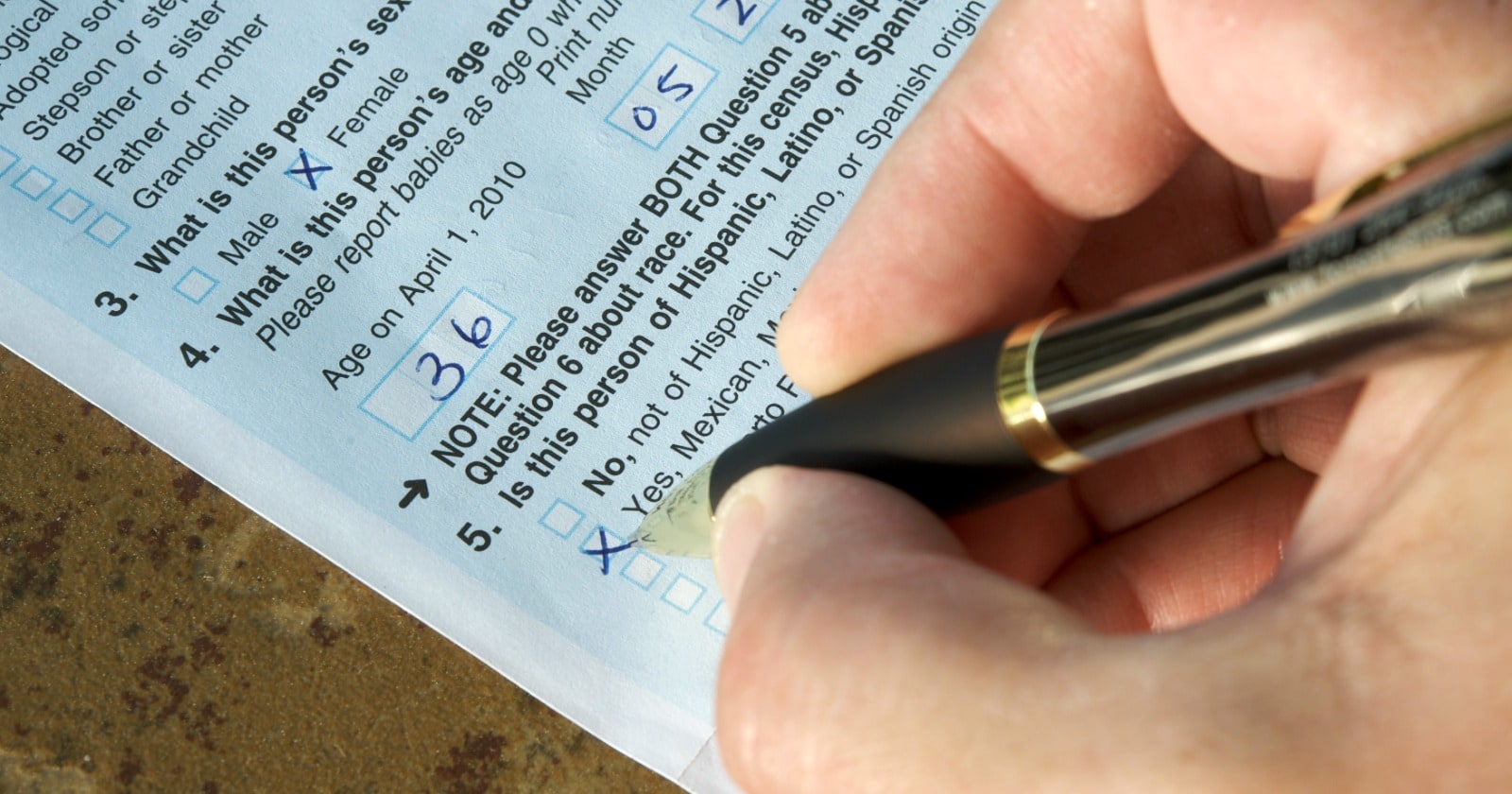
The decennial Census form is intentionally short. According to the Population Reference Bureau, it asks how many people live at the address, the name, age, sex, race, and Hispanic origin of each person, and whether the home is owned or rented. It does not ask for Social Security numbers, bank account information, political party affiliation, religion, or citizenship status. The citizenship question has been proposed and debated across multiple administrations but was not included in the 2020 Census after a Supreme Court ruling blocked it on procedural grounds.
The American Community Survey, sent annually to a sample of about 3.5 million households, asks far more detailed questions - income, employment, housing costs, commute times, education, and more. That is the data that powers the demographic profiles for every city, county, ZIP code, and census tract on CensusEasy.
Add CensusEasy as a preferred source on Google to see our stories first.
What share of the US population was born in another country?
The United States had 50.2 million foreign-born residents in 2024, 14.8 percent of the population. The share ranges from 27.6 percent in California to 2.1 percent in West Virginia.

The US cities where people actually take transit to work
About 3.2% of American workers commute by public transportation. New York is at 44.0%, and every city in the top twelve sits on a rail network built before 1980. No Sun Belt city makes the list.
How Americans actually get health insurance
54.8% are covered through an employer, 20.9% by Medicaid, 18.4% by Medicare, and 8.4% not at all. The eight most uninsured large counties in the country are all in Texas.
Who gets counted in the US Census?
The US Census is designed to count every person living in the United States, regardless of age, citizenship, immigration status, race, income, or housing situation.
Does the Census count noncitizens?
Yes, the Census counts residents rather than only citizens, including undocumented immigrants, visa holders, foreign students, asylum seekers, and legal permanent residents.
Where are people counted in the Census?
People are generally counted at their usual residence, meaning the place where they live and sleep most of the time.