
What Happens If You Don't Fill Out the Census?
See more of our coverage in your search results.
Filling out the census is not optional, at least on paper. Federal law requires every US resident to participate in the decennial Census, and there are penalties on the books for refusal. But the practical reality of what actually happens if you don't respond is a lot more nuanced than the legal language suggests.
What the law says
Census participation is mandatory under Title 13 of the US Code. The statute itself, at 13 U.S.C. Section 221, sets the fine at up to $100 for refusing or neglecting to answer and up to $500 for willfully giving false answers. Those dollar figures are decades old, though. Under the Sentencing Reform Act of 1984 (18 U.S.C. Section 3571), the effective maximum fine for an individual was raised to $5,000. That higher ceiling is often described as an American Community Survey penalty, but it is not ACS-specific: it applies to refusing either the decennial census or the ACS, the ongoing Census Bureau survey that collects more detailed data between the ten-year counts.
You cannot be arrested or jailed for not filling out the census. The penalty is a fine and nothing more, classified as a federal infraction, and no provision of the law puts imprisonment on the table for refusing to respond.
What actually happens in practice
The short answer is: almost certainly nothing. According to the Chicago Urban League's Census FAQ, no one has been prosecuted for failing to respond to the Census since the 1970 Census. That is more than fifty years without a single prosecution for non-response.
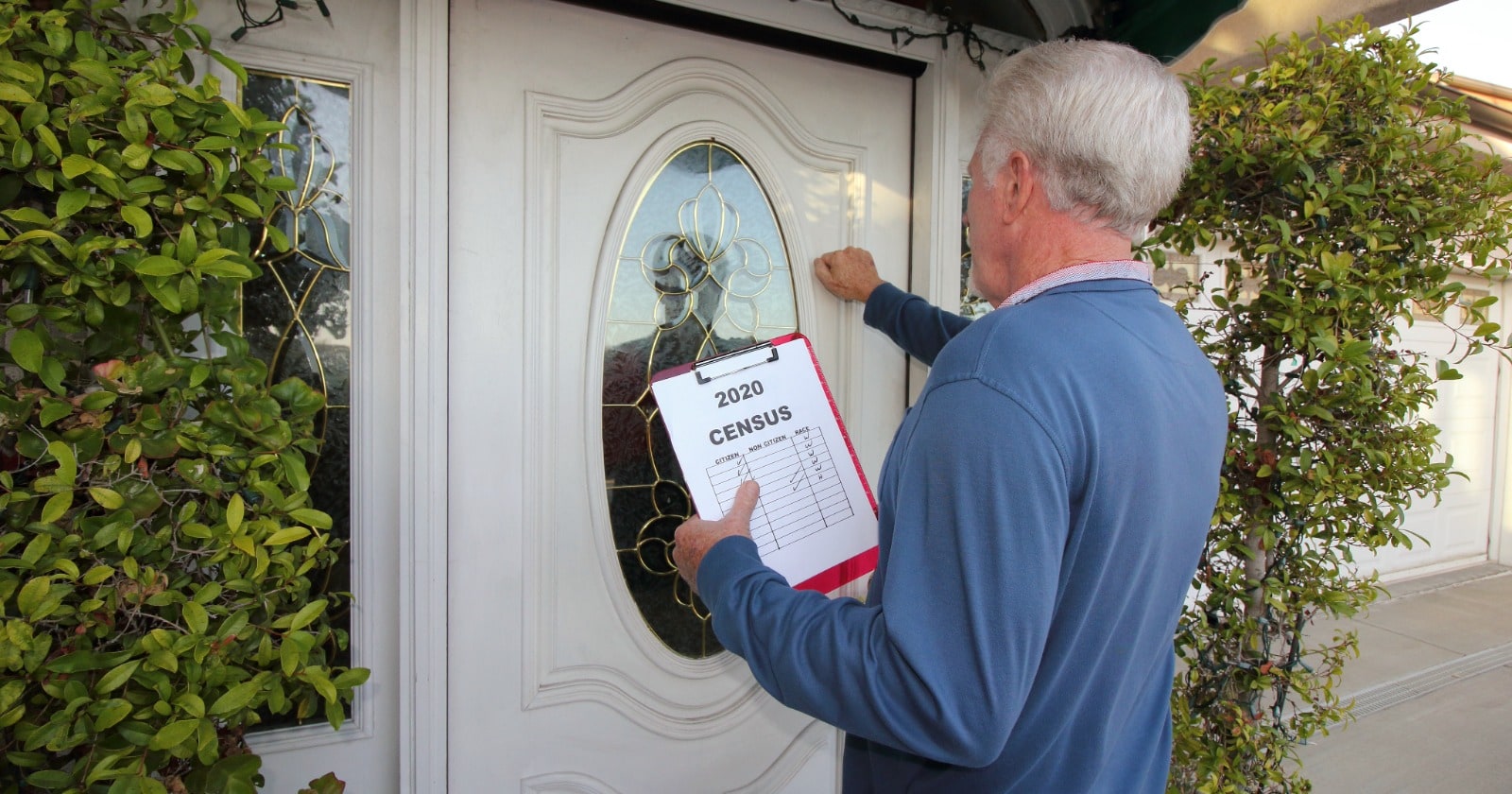
What does happen is a series of follow-up contacts. According to the Chicago Urban League, if you don't respond the Census Bureau will send up to five reminder mailings to your address, followed by an in-person visit from an enumerator - a trained Census Bureau employee who will try to collect the information directly. The Census Bureau's approach is what one expert described to Money magazine as "carrot over the stick" - the bureau wants to convince people that being counted is in the best interest of their family and community, not threaten them into compliance.
If you still don't respond after multiple contacts, the Census Bureau uses administrative records from other government agencies - tax records, social security data, and other federal databases - to fill in the gaps as best it can. Your household will be estimated and counted one way or another, just with less accuracy than if you had responded directly.
Why it matters even if enforcement is rare
The practical consequence of not filling out the census isn't a fine - it's that your community gets a less accurate count, which affects real money and political representation. The U.S. Census Bureau estimates its data guided the distribution of more than $2.8 trillion in federal funding in a single fiscal year, along with the allocation of all 435 congressional seats.
According to Money magazine, that funding covers schools, hospitals, roads, emergency services, and dozens of federal programs. An undercount in your area means your community gets less of that funding than it should. Communities that are traditionally undercounted - renters, young children, low-income households, racial minorities - are the ones that tend to lose the most from low response rates.
What about the American Community Survey?
The American Community Survey is different from the decennial Census. It is sent to a random sample of households every year - roughly 3.5 million addresses annually - and asks more detailed questions about income, housing, employment, education, and commute times. The same mandatory participation rules technically apply, with the same rarely-enforced penalty structure.
If you receive an ACS form, you are legally required to respond. In practice, response rates have declined over the years and enforcement remains essentially nonexistent. But the ACS data is the source of most of the demographic statistics that power tools like CensusEasy - the income figures, poverty rates, housing costs, and educational attainment data for every city, ZIP code, and census tract in the country come from this survey. A lower response rate means less accurate data for everyone who uses it.
The bottom line
If you don't fill out the census, you are technically breaking federal law. You will likely receive follow-up contacts from the Census Bureau. You will almost certainly not be fined and will definitely not be arrested. But your community will have a slightly less accurate count, which has downstream effects on funding and representation that are real even if they're invisible at the individual level.
The data collected through the Census and the American Community Survey is what powers every demographic profile on CensusEasy - every income figure, poverty rate, and home value you see for any city or neighborhood traces back to someone filling out one of these forms.
Add CensusEasy as a preferred source on Google to see our stories first.
 GENERAL
Black household income rises 76% since 1967, but dollar gap with White households widens
Census figures back to 1967 show Black median household income up 76.2 percent after inflation, to $59,980. The ratio to non-Hispanic White income narrowed, but the gap in dollars grew to $36,730.
 GENERAL
These U.S. counties have the highest housing vacancy rates, but they're not abandoned
Sixty-one percent of housing in Summit County, Colorado is vacant. That's Breckenridge, not a ghost town. Every county at the top of the vacancy list is a vacation destination.
 GENERAL
The area codes with the most people
Hawaii's 808 is the most populous area code covering a whole state, with 1.43 million residents. Arizona averages 1.5 million people per code. Here is every state's area codes and residents per code.
Do you have to fill out the Census?
Yes, US residents are legally required to respond to the decennial Census, although penalties for non-response are rarely enforced in practice.
What happens if you don't fill out the Census?
If you do not respond, the Census Bureau will send reminders, may send an in-person enumerator, and may eventually use administrative records to estimate your household.
Can you be fined for not filling out the Census?
Federal law allows fines for refusing to answer Census questions, but prosecutions for Census non-response have not happened in decades.