
How many census tracts are in the US? 84,401, and here is how they are drawn
See more of our coverage in your search results.
The Census Bureau publishes American Community Survey data for 84,401 census tracts in the 50 states and the District of Columbia. Tracts are the small neighborhoods the bureau uses to report data below the county level. The typical tract has 3,773 residents.
Tracts are drawn to hold roughly 1,200 to 8,000 people, with about 4,000 as the target. Because they are sized by population rather than area, a tract in a dense city can cover a few blocks while a rural one can cover hundreds of square miles. Their boundaries are redrawn after each decennial census, and the current map dates from 2020.
Tracts by state
States with more people have more tracts. California has 9,129, more than any other state, followed by Texas with 6,896, New York with 5,397, and Florida with 5,160.
| Most tracts | Tracts | Fewest tracts | Tracts |
|---|---|---|---|
| California | 9,129 | Wyoming | 160 |
| Texas | 6,896 | Alaska | 177 |
| New York | 5,397 | Vermont | 193 |
| Florida | 5,160 | District of Columbia | 206 |
| Pennsylvania | 3,446 | North Dakota | 228 |
| Illinois | 3,265 | South Dakota | 242 |
Wyoming, the least populous state, has the fewest at 160. The District of Columbia, a single city of about 680,000 people, has more tracts than Wyoming, Alaska, or Vermont.
By county, Los Angeles County has 2,498 tracts, more than 40 states and the District of Columbia. Cook County, Illinois, has 1,332 and Harris County, Texas, 1,115. At the other end, 225 counties are a single tract.
Not every tract fits the target
Because tracts are drawn once a decade and population keeps moving, many drift outside the target range. In the 2020 to 2024 American Community Survey, 1,932 tracts had more than 8,000 residents and 1,523 had fewer than 1,200. Another 793 had no residents at all. Those are typically areas such as water, parks, or airports that still have to belong to a tract, since tracts cover every piece of ground in the country.
The most populous tract is tract 6732.02 in Fort Bend County, Texas, in the fast-growing suburbs southwest of Houston, with 44,364 residents. That is more than 11 times the national median, which makes it a candidate for splitting when the map is redrawn after the 2030 census.
How to find your census tract
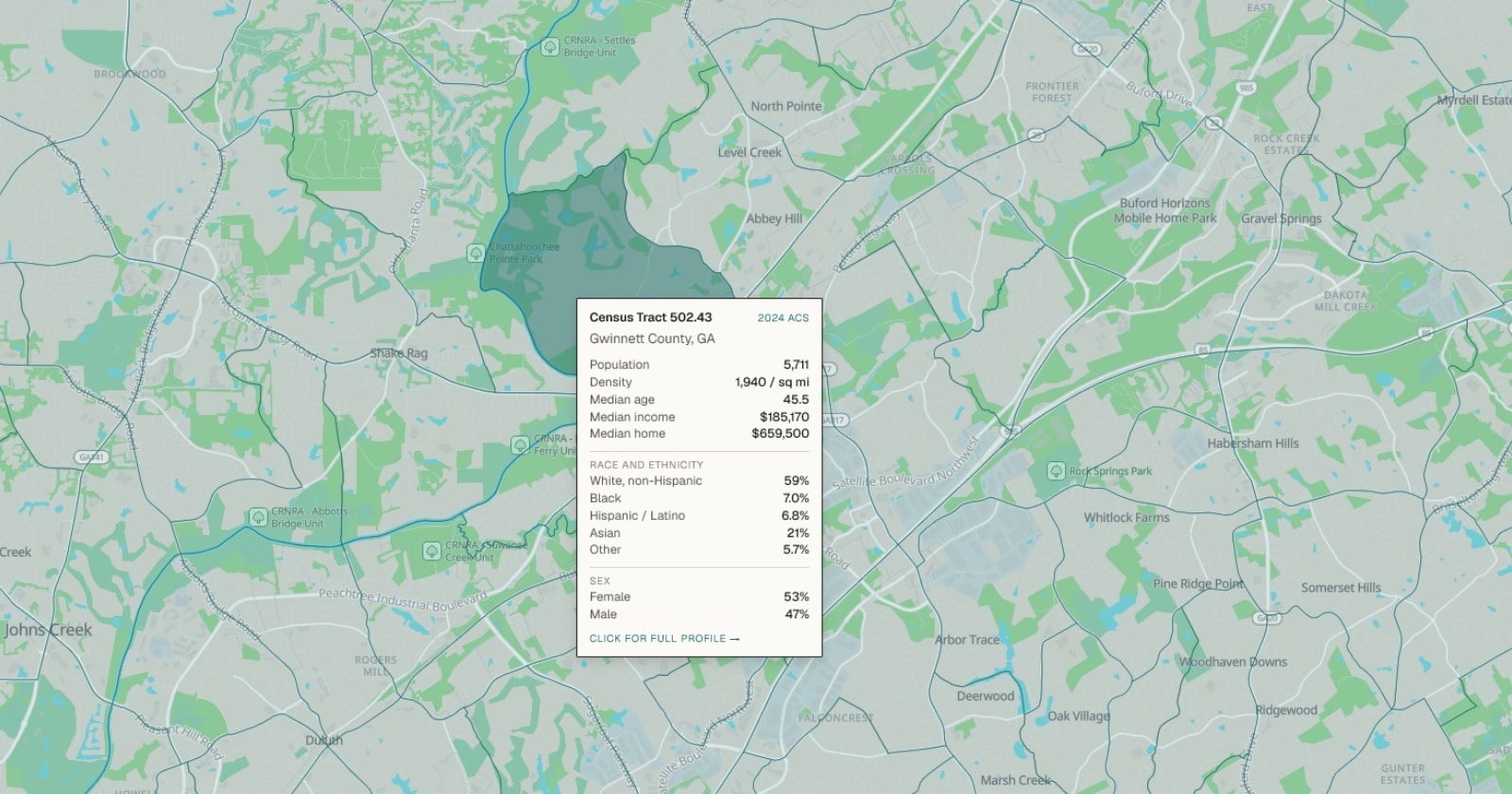
The quickest way is the CensusEasy tract map, which lets you zoom in and click any tract to see its population, income, age, and housing figures. Every county page also lists its tracts. What a tract is, and why the bureau uses them, is explained in what is a census tract, and the outliers are in the most extreme census tracts in America.
Sources
Tract counts and populations are from the U.S. Census Bureau's 2020-2024 American Community Survey 5-year estimates for the 2020 census tract boundaries, covering the 50 states and the District of Columbia. Puerto Rico and the U.S. island areas also have census tracts and are not included in these counts. The 1,200 to 8,000 population range and 4,000 target are from the Census Bureau's criteria for 2020 census tracts.
Add CensusEasy as a preferred source on Google to see our stories first.
 GENERAL
OpenAI agents accessed Census and SEC websites in activity the company is now reviewing
OpenAI is reviewing what it calls misaligned model activity after its agents accessed public Census Bureau and SEC data. The company says it found no use of credentials and no access to nonpublic information.
 GENERAL
Hispanic population by state: California leads, New Mexico is nearly half Hispanic
The U.S. has 64.8 million Hispanic residents, 19.3 percent of the population. California, Texas, and Florida hold more than half, and the fastest growth since 2010 has been in North Dakota and Tennessee.
 GENERAL
How the census has counted race since 1790, and the 2030 plan to stop
Every census since 1790 has recorded race, but the groups on the form have changed decade by decade. Mexican was a race for one census, people chose their own race only from 1960, and multiple races arrived in 2000.
How many census tracts are in the United States?
There are 84,401 census tracts in the 50 states and the District of Columbia on the 2020 tract map used by the American Community Survey. Puerto Rico and the U.S. island areas have additional tracts not included in that count.
How many people live in a census tract?
The Census Bureau draws tracts to hold roughly 1,200 to 8,000 people, with about 4,000 as the target. The typical tract has 3,773 residents. Population shifts between censuses push some well outside that range, and 793 tracts have no residents.
Which state has the most census tracts?
California, with 9,129 tracts, followed by Texas with 6,896, New York with 5,397, and Florida with 5,160. Wyoming has the fewest at 160. By county, Los Angeles County has the most with 2,498.