
How the census has counted race since 1790, and the 2030 plan to stop

See more of our coverage in your search results.
Every U.S. census since the first one in 1790 has recorded race. What has changed is which groups the forms name, who decides what box a person goes in, and whether ethnicity is asked as a separate question. The Trump administration's proposal for the 2030 census would end that 236-year record by dropping the race and ethnicity questions altogether.
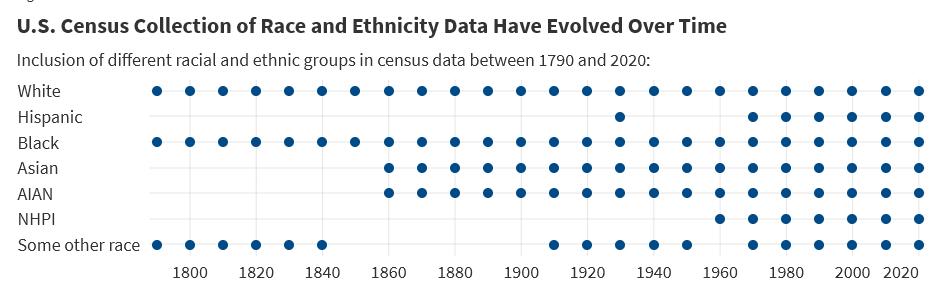
The chart, from the health policy research group KFF and based on the Census Bureau's own timeline, marks each decade a group appeared in census data. White and Black are the only two groups counted in every census. The rest arrived in stages.
How the categories changed
- 1790. The first census sorted people into free white people, all other free persons, and enslaved people. The chart counts that middle group as "some other race" through 1840.
- 1850. Enumerators were told to record Black and "mulatto" residents separately, the first of several mixed-race categories used in the 1800s and early 1900s.
- 1860 and 1870. American Indians and Asians first appear in the chart in 1860. According to Pew Research Center, "Chinese" became the first Asian category used nationwide in 1870.
- 1930. "Mexican" was listed as its own race for the first and only time. It was dropped in 1940, and the chart shows no Hispanic category again until 1970.
- 1960. People could choose their own race for the first time. Before that, a census taker decided. Native Hawaiian and Pacific Islander groups enter the chart the same year.
- 1970 and 1980. A question on Hispanic origin appears in the chart starting in 1970, and it has been on the census form every decade since 1980, asked separately from race.
- 2000. Americans could mark more than one race for the first time.
That two-question format, one question about Hispanic origin and one about race, is what the country has used since. In 2024 the Office of Management and Budget revised the federal standards to combine the two into a single question and to add a Middle Eastern or North African category. The Census Bureau later dropped its plan to put that change into the American Community Survey in 2027, which we covered in the bureau scrapping its race and ethnicity overhaul.
What the current questions show
Under today's two questions, the 2024 American Community Survey counted 340.1 million residents. Of them, 56.3 percent were non-Hispanic white, 20.0 percent Hispanic of any race, 11.7 percent non-Hispanic Black, 6.2 percent non-Hispanic Asian, and 4.6 percent non-Hispanic and of two or more races. American Indian and Alaska Native, Native Hawaiian and Pacific Islander, and some other race each made up less than 1 percent.
| Group | Residents, 2024 | Share |
|---|---|---|
| White, not Hispanic | 191,382,624 | 56.3% |
| Hispanic, any race | 68,013,553 | 20.0% |
| Black, not Hispanic | 39,959,479 | 11.7% |
| Asian, not Hispanic | 21,036,558 | 6.2% |
| Two or more races, not Hispanic | 15,515,949 | 4.6% |
| Some other race, not Hispanic | 1,852,889 | 0.5% |
| American Indian and Alaska Native, not Hispanic | 1,768,838 | 0.5% |
| Native Hawaiian and Pacific Islander, not Hispanic | 581,100 | 0.2% |
These are the figures behind redistricting, Voting Rights Act enforcement, and some tribal grant programs. The administration's 2030 proposal, published this month, would stop collecting them on the census, as covered in the Trump administration's 2030 census proposal.
The history in the chart is one of changing definitions: categories were added, removed, renamed, and eventually left for people to choose themselves. Dropping the questions would create a different kind of break, ending a record that helps show which communities are growing and where they live. The consequences would extend beyond demographic research. Without detailed census data on race and ethnicity, officials and researchers would have less information to assess whether voting maps dilute minority representation, document disparities in housing and health care, and evaluate whether public programs reach the communities they serve. Other surveys could fill some gaps, but their estimates are less precise for small populations and neighborhoods. Changing the categories changes how the country describes itself; eliminating them would make its inequalities harder to measure and address.
How each group has grown is in which race is increasing the most in the United States and which race is decreasing.
Sources
The chart is from KFF's Understanding Racial and Ethnic Identity in Federal Data and Impacts for Health Disparities, based on the U.S. Census Bureau's Decennial Census Measurement of Race and Ethnicity Across the Decades: 1790–2020. Details on the 1850, 1870, 1930, 1960, and 2000 changes are from Pew Research Center's How U.S. census categories used to measure race have changed over time (November 3, 2025). Current population figures are from the 2024 American Community Survey 1-year estimates, table B03002, calculated by CensusEasy.
Add CensusEasy as a preferred source on Google to see our stories first.
 GENERAL
OpenAI agents accessed Census and SEC websites in activity the company is now reviewing
OpenAI is reviewing what it calls misaligned model activity after its agents accessed public Census Bureau and SEC data. The company says it found no use of credentials and no access to nonpublic information.
 GENERAL
Hispanic population by state: California leads, New Mexico is nearly half Hispanic
The U.S. has 64.8 million Hispanic residents, 19.3 percent of the population. California, Texas, and Florida hold more than half, and the fastest growth since 2010 has been in North Dakota and Tennessee.
 GENERAL
New Orleans demographics: two decades after Katrina
New Orleans had 362,154 residents in 2025, about 135,000 fewer than in 1990. The city is majority Black, more educated than ever, and still has one in five homes vacant.
When did the census start asking about race?
With the first census in 1790, which sorted people into free white people, all other free persons, and enslaved people. Race has been recorded on every census since. Until 1960, census takers decided a person's race; since then, people have chosen their own.
When did the census add a Hispanic question?
Mexican was listed as a race once, in 1930, and dropped in 1940. A separate question on Hispanic origin appears starting in 1970 and has been on every census form since 1980, asked separately from the race question.
When could people choose more than one race on the census?
Starting with the 2000 census. In the 2024 American Community Survey, 4.6 percent of residents were non-Hispanic and identified with two or more races, about 15.5 million people.