

Dave Rogan

Black household income rises 76% since 1967, but dollar gap with White households widens
Census figures back to 1967 show Black median household income up 76.2 percent after inflation, to $59,980. The ratio to non-Hispanic White income narrowed, but the gap in dollars grew to $36,730.

Lottery ticket sales nearly doubled to $104.7 billion, and states now keep 33 cents of each dollar
State lottery sales rose from $52.8 billion in fiscal 2008 to $104.7 billion in 2024, Census data show. Prizes grew 118 percent, so states kept 33 percent of sales, down from 39 percent.

Women earned 84 cents for every dollar men made in 2025, Census says
The female-to-male earnings ratio for full-time workers rose to 83.9 percent in 2025, the first significant gain since 2016. Since 1960, women's full-time earnings have more than doubled after inflation.

American household income reaches all-time high of $87,460
U.S. median household income rose 2.6 percent after inflation to $87,460 in 2025, the highest since records began in 1967. Black households gained 4.8 percent, and women's full-time earnings rose 3.2 percent.

Medicaid covers one in three New Mexico residents, compared with one in nine in Utah
About one in five Americans has Medicaid or similar public coverage. New Mexico has the highest share at 33.5 percent and Utah the lowest at 10.9 percent, according to Census Bureau survey data.

The counties with the most 90-degree days, and Texas holds 49 of the top 56
Yuma County, Arizona, and Imperial County, California, each had 156 days of 90-degree heat in 2022, the most of any US county. Texas has 49 of the 56 counties that had at least 90 such days.

The Most Expensive Neighborhoods in America
We ranked the wealthiest neighborhoods across 100 cities by household income and contrasted them with the poorest. The data caps the rich at a ceiling, so the real gap is even wider than it looks.

Factory orders edged up in August as business equipment orders rose 1.6%
New orders for manufactured goods rose 0.1 percent to $663.5 billion in August. Core capital goods orders climbed 1.6 percent while aircraft orders fell, and the order backlog reached $1.61 trillion.

The US cities where most people rent
About 35% of American households rent. In Union City, New Jersey, 80.9% do. Eight of the twelve most renter-heavy cities are in New Jersey, and every city over 500,000 people has a renter majority.

Construction spending rose in August as office building closed in on factories
Construction spending ran at a $2,203.1 billion annual rate in August, up 0.9 percent from July but down 1.7 percent from a year earlier. Office construction, which includes data centers, is now $20.0 billion behind manufacturing.

The largest city in every state
The biggest city in one state can be 190 times the size of the biggest in another. New York tops the list at 8.6 million; Vermont's largest, Burlington, has 44,019. The most populous city in all 50 states and DC.
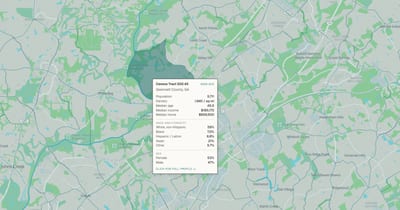
How many census tracts are in the US? 84,401, and here is how they are drawn
The 50 states and DC are divided into 84,401 census tracts, each meant to hold about 4,000 people. California has the most, Wyoming the fewest, and one Texas tract has 44,364 residents.

The most and least diverse states in America, and how much every state changed since 1990
Two random Hawaiians differ in race or ethnicity 89.7 percent of the time. In Vermont it is 23.5 percent. Every state in the country grew more diverse since 1990, Nevada most of all.

What share of the US population was born in another country?
The United States had 50.2 million foreign-born residents in 2024, 14.8 percent of the population. The share ranges from 27.6 percent in California to 2.1 percent in West Virginia.

Trump's plan to exclude some immigrants from the census could cost Texas and Florida House seats
A New York Times analysis finds removing noncitizens without green cards would shift seats from Texas and Florida to Minnesota and Oregon. Our own projection shows why: those states sit right at the cutoff.

Cobb County Went From 88% White to 47% in a Generation
In 1990, Cobb County, Georgia was 87.6 percent white. Today it is 47.1 percent, having crossed into majority-minority, driven by Black, Hispanic, and Asian in-migration at once, and it stayed affluent the whole way.

What is a metropolitan area? How the Census draws the lines around 95% of Americans
A metro area is a group of whole counties tied together by commuting. There are 387 of them plus 538 micropolitan areas, covering 1,844 counties and 323.8 million people.

US poverty rate fell to 10.2% in 2025, and child poverty hit a record low
The official poverty rate dropped for a third straight year to 10.2 percent, with record lows for children and Hispanic Americans. The broader Supplemental Poverty Measure held at 13.1 percent.

Business applications fell 7.8% in August
Americans filed 531,728 business applications in August, down from a July spike but the highest August since records began in 2004. Nearly all of the monthly drop came from retail.

The Fastest-Growing Counties in Florida, 2024 to 2025
Florida added 196,680 residents in a single year. Polk County led in raw numbers and St. Johns County grew fastest by percentage, as the growth concentrated in the suburban ring around Tampa, Orlando, and Jacksonville.