AI is everywhere at work now, but the time savings are smaller than the hype

See more of our coverage in your search results.
More than half of American workers have now used artificial intelligence on the job, according to a new U.S. Census Bureau survey. But when the government asked those workers how much time AI actually saved them, the answer was smaller than the hype: for about 7 in 10, it was two hours a week or less, or nothing at all.
The finding comes from the Census Bureau's Household Trends and Outlook Pulse Survey, which in March 2026 asked workers whether they'd used AI for any of 11 common job tasks. About 55 percent said yes. The tasks were everyday stuff, not science-fiction: searching for technical help, writing emails and documentation, generating ideas, summarizing information, and handling administrative work.
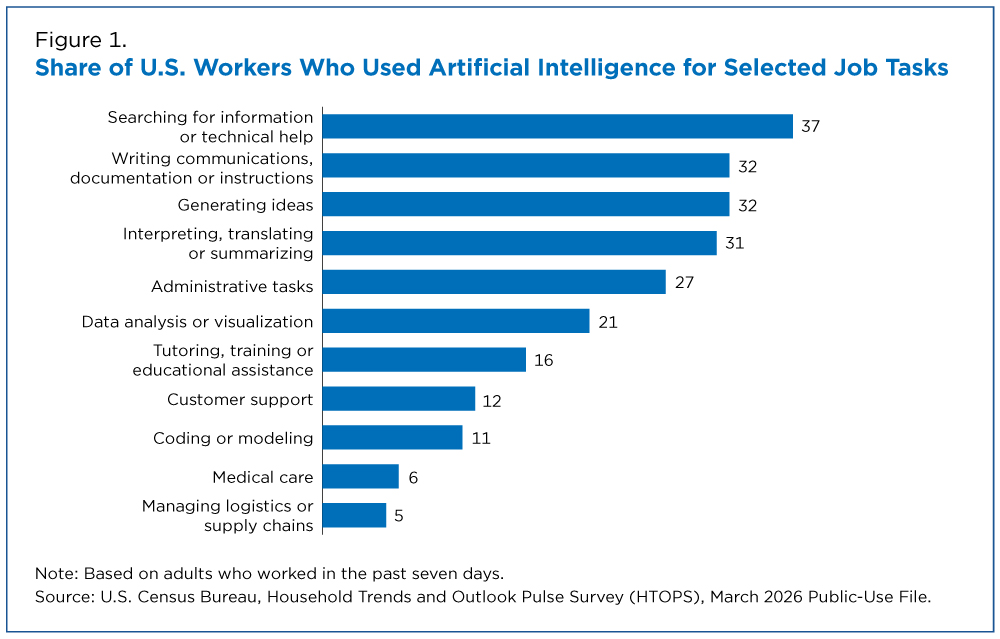
Here's how workers said they used it, with the top five tasks:
- 37 percent used AI to search for information or technical help.
- 32 percent to write communications, documentation, or instructions.
- 32 percent to generate ideas.
- 31 percent to interpret, translate, or summarize information.
- 27 percent to do administrative tasks.
Coding, customer support, and logistics came in lower. The pattern is clear: workers reach for AI as a writing and research assistant far more than as a technical engine.
The time it saves is real but modest
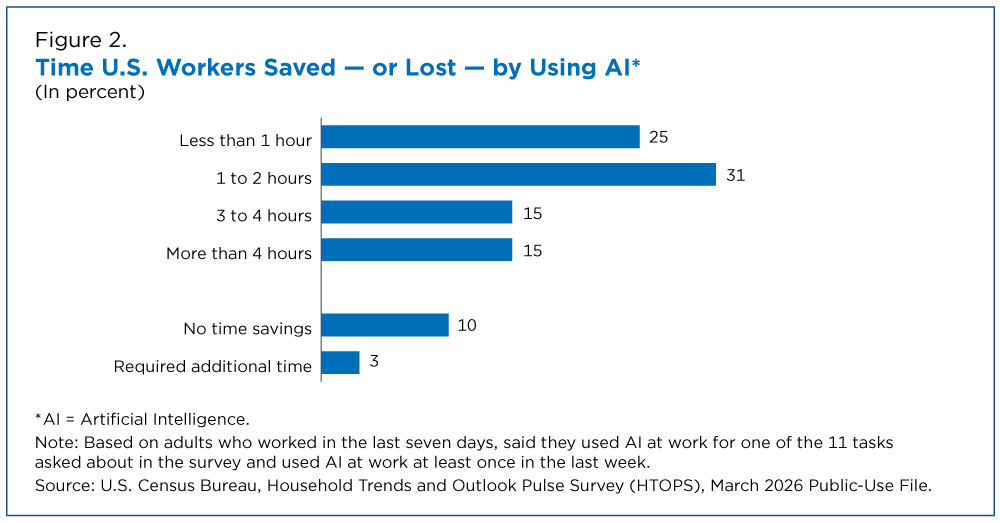
Workers who used AI in the last week were asked how many extra hours they'd have needed to finish the same work without it. The single most common answer, from 31 percent, was one to two hours. A quarter said less than an hour. Add in the 10 percent who said AI saved no time and the 3 percent who said it actually cost them time, and about 69 percent of users landed at two hours or less, or worse.
The bigger savings were real but rarer. Fifteen percent said AI cut three to four hours from their week, and another 15 percent said more than four hours. So roughly a third of users got a meaningful chunk of time back, and the rest got a trim.
One caveat: these are workers' own estimates, not measured productivity. So people are guessing at a counterfactual, how long a task "would have" taken the hard way.
Among workers who used AI for any task, only 24 percent used it every day in the last week. Another 46 percent used it at least once, and 30 percent didn't touch it at all. Most workers have tried AI on the job; far fewer have folded it into the daily routine.
The real divide is education
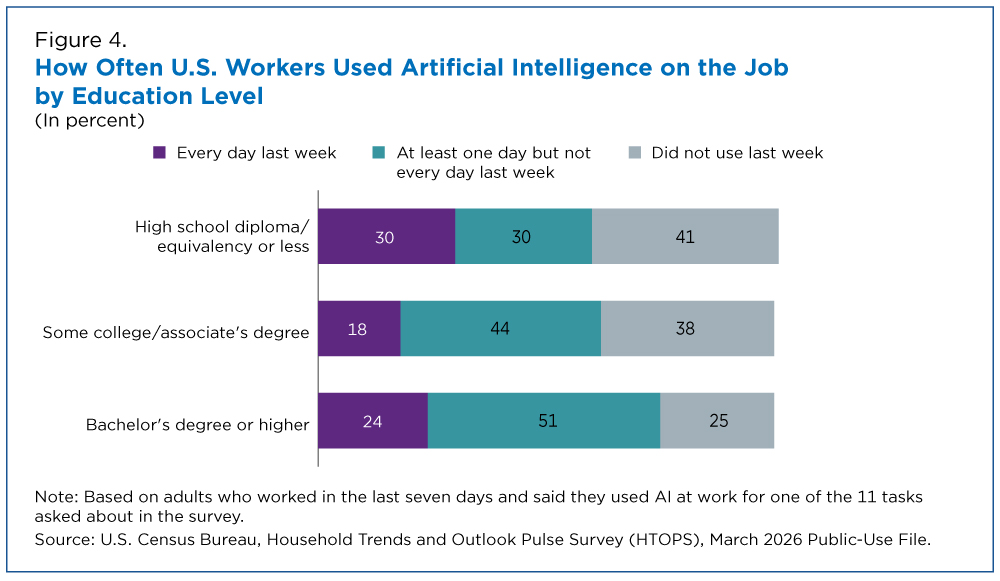
Workers with a bachelor's degree or higher used AI more than workers without one. To interpret, translate, or summarize information, 46 percent of degree-holders used AI, compared with 25 percent of those with some college and just 16 percent of those with a high school diploma or less. Asked how often they used it, 75 percent of degree-holders said at least one day in the past week, against 62 percent with some college and 59 percent with a high school education.
AI at work isn't spreading evenly. It's concentrating among the workers who already have degrees, higher pay, and desk jobs, the same group that captured most of the gains in our look at whether middle-class incomes are rising. A tool that saves the already-advantaged an hour here and there, while barely reaching everyone else, widens a gap rather than closing it.
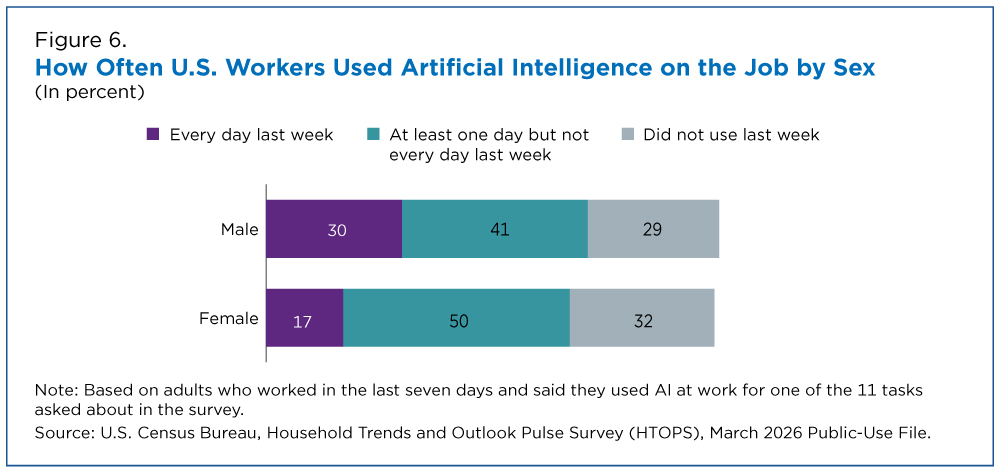
The splits by sex and age point the same way. Thirty percent of male workers used AI daily, versus 17 percent of women. Younger workers, ages 18 to 49, used it more than workers 50 and up for four of the top five tasks. The early adopters of workplace AI are, so far, a fairly specific slice of the workforce.
This all comes from a Census Bureau survey, one of the many the Bureau runs beyond the once-a-decade count. If you're fuzzy on what the census actually is, we explain it in what census means.
Sources
Figures are from the U.S. Census Bureau's America Counts story on AI use at work (August 2026), drawn from the March 2026 Household Trends and Outlook Pulse Survey. The underlying data, which also cover employment, mental health, and social connectedness, are in the HTOPS March 2026 table package. The Bureau tested all comparisons at the 90 percent confidence level. The distribution of time saved, and the roughly 69 percent of users at two hours or less, are computed from the survey's own reported shares.
Add CensusEasy as a preferred source on Google to see our stories first.
 GENERAL
New home sales rose in August as July's slump shrank on revision
New single-family home sales ran at a 684,000 annual rate in August. The gain is within the margin of error, but July's reported 10.5 percent drop was revised to about 4 percent, and Midwest sales jumped 85 percent.
 GENERAL
Detroit has the highest unemployment rate among large US cities
Among big cities, unemployment runs from 14.0 percent in Detroit to 2.5 percent in Sioux Falls. California's farm counties carry the highest county rates in the country.
 GENERAL
The largest city in every state
The biggest city in one state can be 190 times the size of the biggest in another. New York tops the list at 8.6 million; Vermont's largest, Burlington, has 44,019. The most populous city in all 50 states and DC.
How many US workers use AI at work?
About 55 percent of US workers said they had used artificial intelligence on the job for at least one of 11 tasks, according to the Census Bureau's March 2026 Household Trends and Outlook Pulse Survey. But regular use is narrower: among AI users, only 24 percent used it every day in the past week, while 30 percent didn't use it at all.
How much time does AI save workers?
For most, not much. Among workers who used AI in the last week, 31 percent said it saved one to two hours and 25 percent said less than an hour. Counting those who saved no time or lost time, about 69 percent landed at two hours or less. Roughly a third saved three or more hours. These are workers' own estimates, not measured productivity.
Who uses AI most at work?
Use is concentrated among more educated workers. Some 75 percent of workers with a bachelor's degree or higher used AI at least one day in the past week, compared with 59 percent of those with a high school education or less. Men used AI daily more than women, 30 percent to 17 percent, and workers under 50 used it more than older workers for most top tasks.