
Which State Has the Largest Population? All 50 States Ranked

See more of our coverage in your search results.
California has the largest population of any U.S. state, with 39,287,377 residents. That is more people than live in the 21 smallest states put together, and it has held the top spot for decades. The question most people are really asking when they search for the biggest state is whether that lead is safe. It is not as safe as it used to be.
The United States has about 334,922,499 people spread across 50 states plus the District of Columbia, and they are not spread evenly. The top four states hold roughly a third of the country. The bottom handful barely register against them. Here is the full top of the ranking, and then the part that matters more, which is who is moving up and who is moving down.
The 11 largest states
The order at the top is a familiar one, but the gaps between the names tell the real story.
1. California - 39,287,377. Still first, and by a wide margin, though it lost population in the most recent estimate.
2. Texas - 30,188,424. Second, and growing faster than any large state in the country.
3. Florida - 22,416,077. Third, and also one of the fastest-growing states.
4. New York - 19,852,366. Fourth, and shrinking faster than any other state.
5. Pennsylvania - 13,018,639.
6. Illinois - 12,694,798.
7. Ohio - 11,810,293.
8. Georgia - 10,940,407.
9. North Carolina - 10,730,404.
10. Michigan - 10,077,761.
11. New Jersey - 9,343,809.
The full count for all 50 states sits on the largest-population-states ranking, but the shape of it is clear from the first ten. After California and Texas, the drop to Florida is about eight million, and from Florida to New York is another two and a half million. By the time you reach the bottom of this list, the differences shrink to a few hundred thousand at a time.
The smallest states
At the other end, Wyoming is the least populated state in the country at 582,397 people. That is fewer residents than most large American cities. Vermont follows at 647,106, and the District of Columbia, which is not a state, sits between them in raw count at 681,294. Then come Alaska at 735,706, North Dakota at 784,841, and South Dakota at 907,428.
The distance here is hard to overstate. California holds roughly 67 times as many people as Wyoming, yet each state sends the same two senators to Washington. The population question is never only about counting heads. It decides how many House seats a state gets, how many electoral votes it carries, and how federal dollars are split.
Who is growing and who is shrinking
A snapshot ranking hides the more useful information, which is direction. Look across the growth numbers and the pattern is consistent enough to call it a formula. The states gaining people fastest are in the South and the Mountain West, and the ones losing people are concentrated in the Northeast and the older industrial Midwest.
Idaho leads the country in growth rate at +5.17% in the most recent year. Florida is next at +4.08%, then Utah at +3.69%, Texas at +3.58%, and South Carolina at +3.47%. The full set is on the fastest-growing-states ranking. Three of those five are warm-weather states with lower housing costs and no state income tax, which is most of the explanation right there.
The decline list runs the other way. New York shed population at -1.73%, the steepest drop in the country. Louisiana fell -0.98%, Illinois -0.92%, West Virginia -0.86%, and California itself -0.63%. These are not states that hit a single bad year. Most of them have been losing residents to cheaper, faster-growing states for a long stretch, and the recent numbers are the continuation of a trend rather than a break from it.
That is the thread worth pulling. California is first and California is shrinking, both at once. A -0.63% decline on a base of 39 million still leaves it far ahead, so the title is safe for now. But Texas is adding people at +3.58% on a base of 30 million, and California is subtracting them. Run those two rates forward and the eight-million gap between them narrows every single year. Florida, growing at +4.08%, is doing the same thing to fourth place and beyond. The ranking at the top has been stable for a generation, but the engines underneath it have reversed.
If you want to see where this is heading, the two rankings to watch together are the largest states by population and the fastest-growing states, because the first tells you the standings and the second tells you the score still being run up. You can also put any two states side by side on the compare tool and watch the math close the distance for yourself.
Sources
Population figures are from the U.S. Census Bureau Population Estimates Program, compiled on the CensusEasy largest-population-states and fastest-growing-states rankings.
Add CensusEasy as a preferred source on Google to see our stories first.
 GENERAL
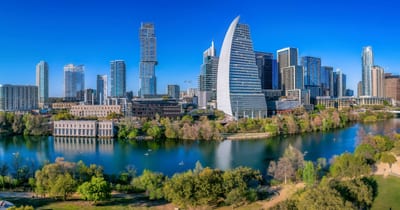
Before you move to Austin: what the census data says
Austin doubled in size since 1990 and home values jumped about 55% since 2020. Here's what the Census numbers actually show about the city, the metro, and the suburban ring before you make the move.
 GENERAL
St. Louis has lost 30% of its people since 1990, but the region around it hasn't
The city of St. Louis had 278,144 residents in 2025, down from 396,685 in 1990. The metro area grew over the same period, and nearly all the loss is inside city limits that haven't changed since 1876.
 GENERAL
Black household income rises 76% since 1967, but dollar gap with White households widens
Census figures back to 1967 show Black median household income up 76.2 percent after inflation, to $59,980. The ratio to non-Hispanic White income narrowed, but the gap in dollars grew to $36,730.
Which state has the largest population?
California has the largest population of any U.S. state, with 39,287,377 residents in the latest Census Bureau estimate. Texas is second at 30,188,424 and Florida is third at 22,416,077.
What is the smallest state by population?
Wyoming is the smallest state by population, with 582,397 residents. Vermont is next at 647,106, followed by Alaska at 735,706, North Dakota at 784,841, and South Dakota at 907,428.
Which state is growing the fastest?
Idaho is growing the fastest at +5.17% in the most recent year, followed by Florida at +4.08%, Utah at +3.69%, Texas at +3.58%, and South Carolina at +3.47%.