
How the Rust Belt Lost Its Factory Jobs
See more of our coverage in your search results.
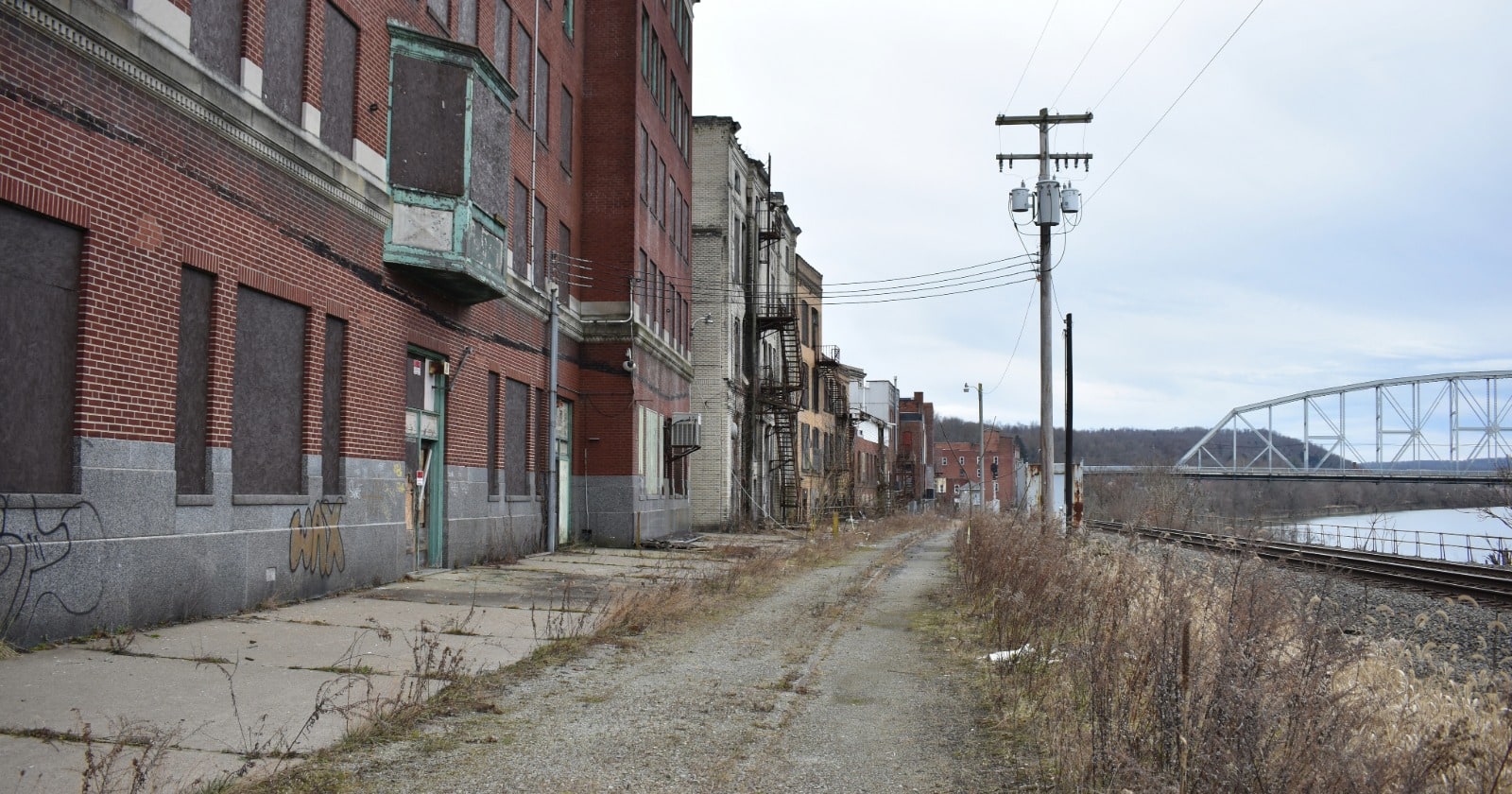
The term Rust Belt describes a band of the country that ran on heavy industry: steel in Pittsburgh and Youngstown, autos in Detroit and Flint, the full range of metal-bending manufacturing across the Great Lakes. For most of the 20th century these cities were the most productive places in the American economy. Then the economy that built them came apart.
National manufacturing employment peaked at about 19.5 million jobs in 1979, according to the Bureau of Labor Statistics, and fell to roughly 12 million by the 2010s. Automation did much of it, replacing assembly-line labor with machines. Trade and offshoring did more, moving production to lower-cost regions and countries. The losses were not spread evenly. They concentrated in the cities most dependent on a single industry, and the Census record lets you see exactly how hard each one was hit.
The auto cities
Detroit is the largest casualty. It fell from 1,027,974 residents in 1990 to 638,530 in 2024 as the auto industry automated and decentralized. Flint, Michigan, an hour north, was even more concentrated in a single employer and shows it: the city dropped from 140,761 people in 1990 to 80,175 in 2024, a loss of 43 percent. Flint's home values tell the story in miniature. The median home was worth $33,800 in 1990, climbed during the bubble, then collapsed to $30,000 by 2016, lower in nominal terms than a quarter century earlier. A city whose housing is worth less than it was in 1990 is a city whose economic foundation gave way.
The steel cities
The steel towns followed the same curve on a different schedule. Youngstown, Ohio lost its mills starting on a single day in 1977, an event locals still call Black Monday, and the city fell from 95,732 residents in 1990 to 59,331 in 2024. Its poverty rate today sits at 37.3 percent, among the highest of any city in the country. We tell that story in full in our piece on Youngstown.
Gary, Indiana, built by US Steel and named after its chairman, is the starkest case by percentage. It dropped from 116,646 residents in 1990 to 68,113 in 2024, a 42 percent loss, as the steel mills that were the city's entire reason for existing cut their workforce again and again. Cleveland, Ohio, a more diversified industrial city, fell more gently, from 505,616 to 366,097, a 28 percent decline.
The cities that found a second act
Not every industrial city kept falling. Two of them, in particular, show what a recovery looks like in the data. Pittsburgh was the steel capital of the world and lost a fifth of its population, from 369,879 in 1990 to 304,759 in 2024. But it stopped declining and pivoted hard into healthcare, higher education, and technology. Median household income in Pittsburgh more than tripled in nominal terms over the period, from $20,747 in 1990 to $65,742 in 2024, and home values rose from $40,500 to $205,800. Pittsburgh did not get its steel jobs back. It replaced them with a different economy.
Buffalo, New York tells a similar stabilization story. It lost population for decades, from 328,123 in 1990 down toward 256,000 by 2019, then actually grew, reaching 278,349 in the 2020 count and holding above 276,000 since. Its median home value more than doubled from 2014 to 2024, and its poverty rate, while still high at 26 percent, has started to fall. Buffalo's turnaround came from immigration, healthcare and education employment, and the simple fact that it had become cheap enough to attract people priced out of bigger metros.
What the pattern means
The Rust Belt cities that recovered share a feature: they replaced a single dominant industry with a diversified base, usually anchored by hospitals and universities, the so-called eds-and-meds economy. The ones still struggling, Gary, Flint, Youngstown, were the most dependent on one employer and had the hardest time building anything to replace it. The lesson in the data is that concentration was the vulnerability. A city built on one industry rises and falls with it.
You can trace the full population and income series for any of these cities from 1990 to today on its place page, and the broader regional decline shows up in our rankings of the fastest-shrinking cities and fastest-shrinking counties. For the single most extreme example of a city losing its population, see our account of how Detroit lost half its population, including the recent signs that it has finally turned a corner.
Sources
Figures in this article come from the following public datasets, accessed through CensusEasy:
- US Census Bureau, American Community Survey 5-year estimates: census.gov/programs-surveys/acs
- US Census Bureau, Decennial Census (1990 and 2000 summary files): census.gov/programs-surveys/decennial-census.html
- US Bureau of Labor Statistics, manufacturing employment series: bls.gov/ces
- CensusEasy methodology and inflation adjustments: censuseasy.com/methodology
Add CensusEasy as a preferred source on Google to see our stories first.
 INDUSTRY
Cobb County Went From 88% White to 47% in a Generation
In 1990, Cobb County, Georgia was 87.6 percent white. Today it is 47.1 percent, having crossed into majority-minority, driven by Black, Hispanic, and Asian in-migration at once, and it stayed affluent the whole way.
 INDUSTRY
How Did Obamacare Affect the Uninsured Rate in America?
In 2013, 14.9 percent of Americans had no health insurance. Today it is 8.4 percent, a drop of about 18 million people. But all of the gains came before 2019, and the line has been flat ever since.
 INDUSTRY
Gwinnett County Went From 90% White to 30%: The Most Diverse Counties in America
In 1990, Gwinnett County, Georgia was 89.6 percent white. Today no group holds even a third of the population, and it ranks fourth in the nation on the CensusEasy Diversity Score. Here are the most diverse counties in America.
Why did the Rust Belt lose its manufacturing jobs?
Rust Belt manufacturing jobs were lost to automation, which replaced assembly-line workers with machines, and to trade and offshoring, which moved production to lower-cost regions and countries. National manufacturing employment fell from about 19.5 million in 1979 to roughly 12 million by the 2010s.
Which Rust Belt city lost the most population?
By absolute numbers, Detroit lost the most, falling from over a million residents in 1990 to 638,530 in 2024. By percentage, Flint and Gary were hit hardest, each losing more than 40 percent of their 1990 population.
Did any Rust Belt cities recover?
Yes. Pittsburgh and Buffalo both stabilized by replacing single-industry manufacturing with diversified economies anchored by healthcare, higher education, and technology. Pittsburgh's median income more than tripled, and Buffalo's population grew again after decades of decline.