
Black Monday and What Followed: How Youngstown, Ohio Lost Two Thirds of Its Population
See more of our coverage in your search results.
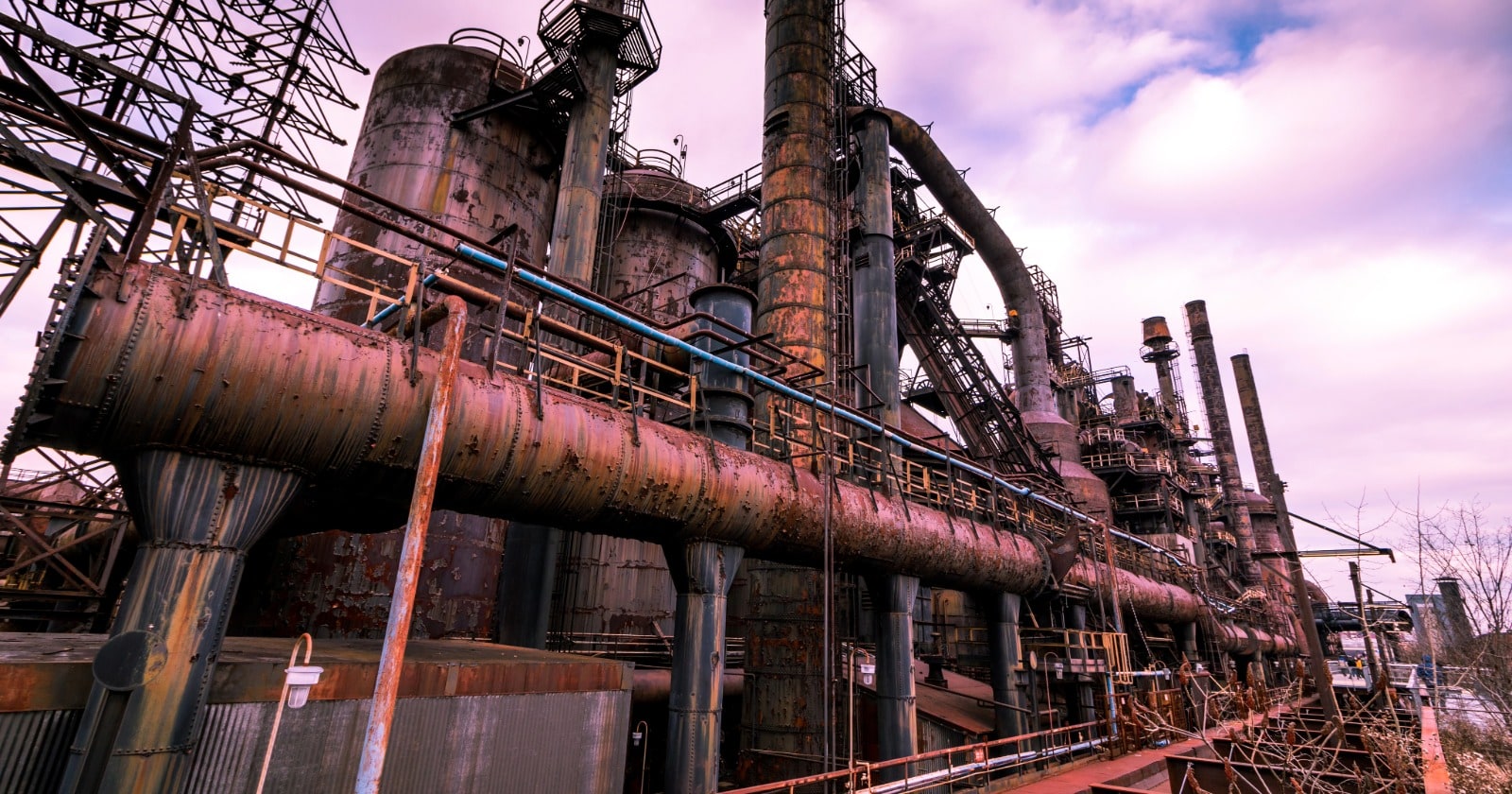
On the morning of September 19, 1977, workers at the Youngstown Sheet and Tube Campbell Works showed up for their shifts and were told the plant was closing. More than 5,000 people lost their jobs that day. Locals called it Black Monday, and the name stuck because what happened next made clear it wasn't just a plant closure. It was the beginning of a decades-long collapse that would cut the city's population by more than half and leave behind one of the most striking examples of urban decline in American history.
Youngstown, Ohio had 170,002 residents in 1930, when its steel mills were running around the clock and its downtown was packed with department stores, theaters, and restaurants serving one of the most prosperous blue-collar workforces in the country. Today the city has fewer than 60,000 people. The median home value is $63,300. The poverty rate is 37.3%. Median household income sits at $34,408, less than a third of what a comparable household earns in the suburbs surrounding the city.
These numbers didn't happen overnight, and understanding why they look the way they do requires going back further than Black Monday.
What Youngstown was before the steel industry died
Youngstown in the first half of the twentieth century was genuinely prosperous in a way that's hard to square with what the Census data shows today. The city sat at the center of the Mahoning Valley, a stretch of northeast Ohio and western Pennsylvania that was one of the most productive steel-producing regions on earth. The valley had everything the industry needed: coal from Appalachia, iron ore from the Great Lakes, and rail connections to move finished steel to manufacturers across the country.
The steel mills ran 24 hours a day, seven days a week, and they paid wages that supported a middle-class lifestyle for workers without college degrees. At its peak the city had one of the highest homeownership rates in the country, which meant the wealth being generated in the mills was flowing into neighborhoods and staying there. Immigrants came from Southern and Eastern Europe, from the Mediterranean, and later from the American South as part of the Great Migration. By 1920 roughly four out of five Youngstown residents were either immigrants or first-generation Americans. The city built itself around these communities, with neighborhood churches, ethnic social clubs, and a dense downtown that served a dense and employed population.
The 1930 population peak of 170,002 came right as the Great Depression arrived, and the city never grew beyond that number. But it stayed relatively stable through World War II, when demand for steel to build ships, tanks, and weapons kept the mills producing at capacity, and through the postwar boom years when American steel faced essentially no global competition. The 1950s and early 1960s were the last years when Youngstown looked like a city with a future that matched its past.
Black Monday and what followed
The signs of trouble had been building through the 1970s. Foreign steel, particularly from Japan and West Germany, was undercutting American producers on price because their postwar plants were newer and more efficient than mills built in the 1920s. American steel companies had underinvested in modernization for decades, relying on the captive market of postwar American manufacturing. By the mid-1970s that market was eroding, and the companies that owned the Mahoning Valley mills were looking for exits.
When Youngstown Sheet and Tube closed the Campbell Works in September 1977, it set off a cascade. Within five years of Black Monday, 50,000 jobs had disappeared from the Mahoning Valley. Not just steelworker jobs but the entire web of businesses that had existed to serve the people who held those jobs: the diners, the hardware stores, the car dealerships, the taverns. When the mills closed, the tax base collapsed, city services deteriorated, and the people who could leave did. The population dropped from 140,909 in 1970 to 115,436 in 1980 to 95,732 in 1990, each decade worse than the last.
What the Census data shows across 35 years
The trajectory visible in CensusEasy's historical data is relentless. Every decade from 1970 to today has added another layer of decline. The city that had 170,000 residents at its peak had 115,000 by 1980, 95,000 by 1990, 82,000 by 2000, and fewer than 67,000 by 2010. The most recent estimates put the population below 60,000. That's a city that lost more than two thirds of its population in roughly sixty years, and the losses compound on themselves because each wave of departures makes the city less attractive to the people who remain.
The surrounding communities tell a similar story. Warren, about 15 miles northwest of Youngstown, peaked at 63,494 residents in 1970 and has been declining ever since. Its median household income today is $37,887, its poverty rate is 31.9%, and its median home value of $86,400 reflects a housing market where demand has not recovered from the industrial collapse. Campbell, which sits directly adjacent to Youngstown and was named after the Campbell Works that started the whole collapse, has a poverty rate of 31.1% and a median home value of $82,300. The entire Mahoning County carries a poverty rate of 18.9%, nearly double the national average, and a median household income of $56,942 that reflects how thoroughly the region's economic base was hollowed out.
Youngstown's 37.3% poverty rate deserves specific attention because it's not a rounding error or a measurement artifact. More than one in three residents lives below the federal poverty line. For context, the national poverty rate is around 12%. Youngstown's rate is three times that. It ranks among the poorest cities of any size in the United States, and it has been in that category for decades, which means an entire generation of children has grown up in conditions of concentrated poverty that research consistently shows have lasting effects on educational attainment, health, and economic mobility.
The shrinking city experiment
Youngstown's response to its population collapse is worth knowing about because it was genuinely unusual in American urban planning. Rather than pursuing the standard playbook of trying to attract new industry and grow its way back to a larger population, the city adopted a "shrinking city" master plan in 2005 that acknowledged the population loss as permanent and tried to right-size the city's infrastructure to match its actual size. Abandoned homes were demolished rather than left to deteriorate. Vacant lots were converted to green space. City services were concentrated in the neighborhoods with the highest remaining population density rather than spread thin across the entire footprint.
The plan attracted significant attention from urban planners nationally and internationally, partly because no American city had ever explicitly planned for permanent decline rather than treating it as a temporary condition to be reversed. Whether it has worked is a complicated question. The poverty rate has not meaningfully improved. The population has continued to fall. But the physical condition of the city's occupied neighborhoods is better than it would have been if the abandoned housing stock had been left standing, and the approach has at least given city government a coherent framework for allocating limited resources.
What $63,300 buys you in Youngstown
The median home value figure is the one that most visibly captures how differently Youngstown's housing market functions compared to the rest of the country. At $63,300, you can buy a house in Youngstown for roughly what a used car costs in most American cities. There are neighborhoods within the city limits where structurally sound homes sell for under $30,000. The low prices reflect low demand, which reflects the population loss, which reflects the job loss, which started in September 1977 and never stopped.
For buyers who work remotely and can tolerate a city with genuine challenges, those prices represent something real. A handful of artists, entrepreneurs, and remote workers have moved to Youngstown specifically because the cost of living is low enough to make projects viable that wouldn't pencil out anywhere else. Whether that trickle becomes something larger depends on whether remote work permanently restructures where people are willing to live, and whether Youngstown's infrastructure can support the kind of lifestyle that attracts mobile workers.
The Census data will keep measuring the answer to that question over the coming decades. So far, the trajectory has been one direction for fifty years. The data is there for anyone who wants to watch it.
You can explore the full demographic profile for Youngstown and trace its numbers from 1990 to today, or compare it directly to any other city using the Compare tool.
Add CensusEasy as a preferred source on Google to see our stories first.
 DECLINE
The Fastest-Shrinking Cities in America
The fastest-shrinking large cities split into two very different stories: people priced out of the expensive coasts, and the long structural decline of the South and Midwest. Here is why you shouldn't read them as the same trend.
 DECLINE
How Detroit Lost Half Its Population, and Why It Is Finally Growing Again
Detroit had more than a million residents in 1990 and 1.85 million at its 1950 peak. By 2024 it had fallen to 638,000, one of the steepest urban declines in American history. But the latest Census numbers show something that has not happened in 70 years: the population went up.
 DECLINE
The Poorest Cities in America: What the Census Data Actually Shows
The federal poverty rate for the United States sits at around 12%. The cities on this list are running at two to three times that figure, and most of them have been for decades. These are not cities that hit a rough patch. They are places where concentrated poverty has been the structural reality for a generation or more, driven by deindustrialization, population loss, disinvestment, and the compounding effects of each of those forces on the next...
Why did Youngstown, Ohio decline so much?
Youngstown declined after the steel industry collapsed, starting with the 1977 Campbell Works closure that triggered massive job losses, population loss, and a shrinking tax base.
What was Black Monday in Youngstown?
Black Monday was September 19, 1977, when Youngstown Sheet and Tube closed the Campbell Works and more than 5,000 workers lost their jobs.
How much population has Youngstown lost?
Youngstown peaked at 170,002 residents in 1930 and now has fewer than 60,000 people, meaning the city has lost more than two thirds of its peak population.