US parents gave $26.6 billion to grown children who moved out

See more of our coverage in your search results.
About 2.6 million U.S. parents gave $26.6 billion in 2024 to 3.7 million grown children who no longer lived with them, the Census Bureau reported September 30. The typical parent who gave money handed over $4,725 during the year.
The estimates come from the bureau's Survey of Income and Program Participation, which asks about voluntary support to specific people outside the household, including children 21 or older. The money could come as a lump sum or in regular payments, and it often covers bills, food, and other everyday costs. Support for children away at school who still count as part of the parent's household is excluded, as is anything spent on adult children living at home.
Most of these parents (72.7 percent) supported one adult child. Another 18.8 percent supported two, and 8.6 percent supported three or more.
The median is $4,725 but the average is much higher. Dividing $26.6 billion by 2.6 million parents works out to roughly $10,200 each, more than double the median, which suggests a smaller group of parents gave large sums.
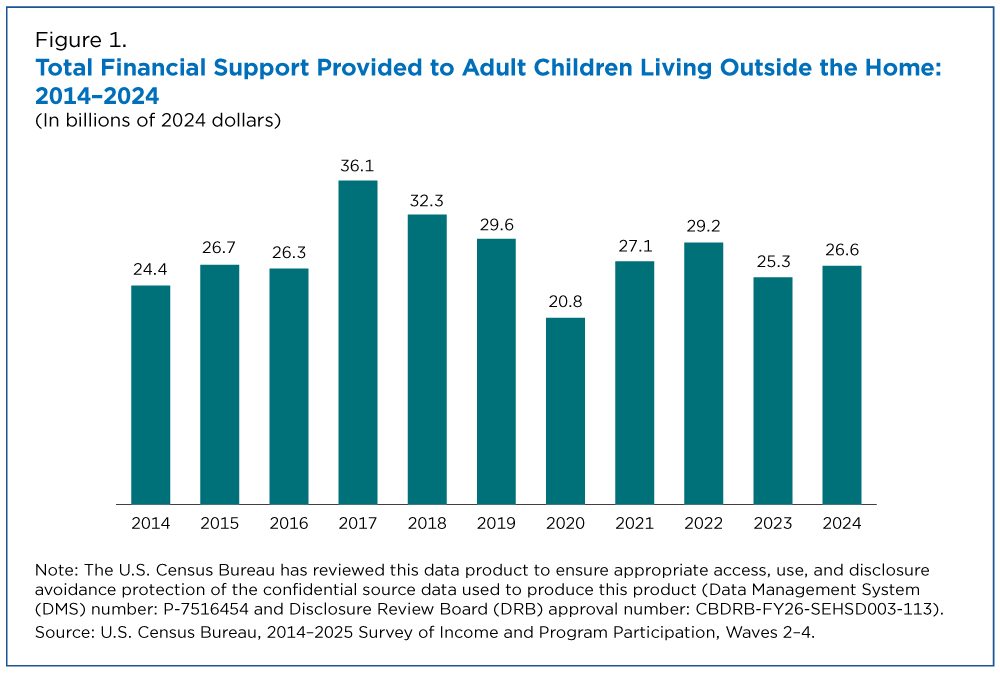
Adjusted for inflation, the yearly total has swung between $20.8 billion and $36.1 billion over the past 11 years. The bureau said support rose significantly in 2017, to $36.1 billion, and stayed high in 2018, a period when workers' earnings were also climbing. It then fell significantly in 2020, the first year of the COVID-19 pandemic, to $20.8 billion. The 2024 total was $26.6 billion, compared with $25.3 billion in 2023.
Who gives
Parents 36 and older who supported an adult child living elsewhere looked different compared to other parents in that age group. They were more likely to be men (55.7 percent men vs. 46.1 percent), to be employed (68.3 percent vs. 58.0 percent), to hold at least a bachelor's degree (46.0 percent vs. 36.8 percent), to be divorced (20.8 percent vs. 14.3 percent), and to have income from stocks or bonds (21.8 percent vs. 16.8 percent). They were less likely to have been born in the United States (70.3 percent vs. 77.5 percent).
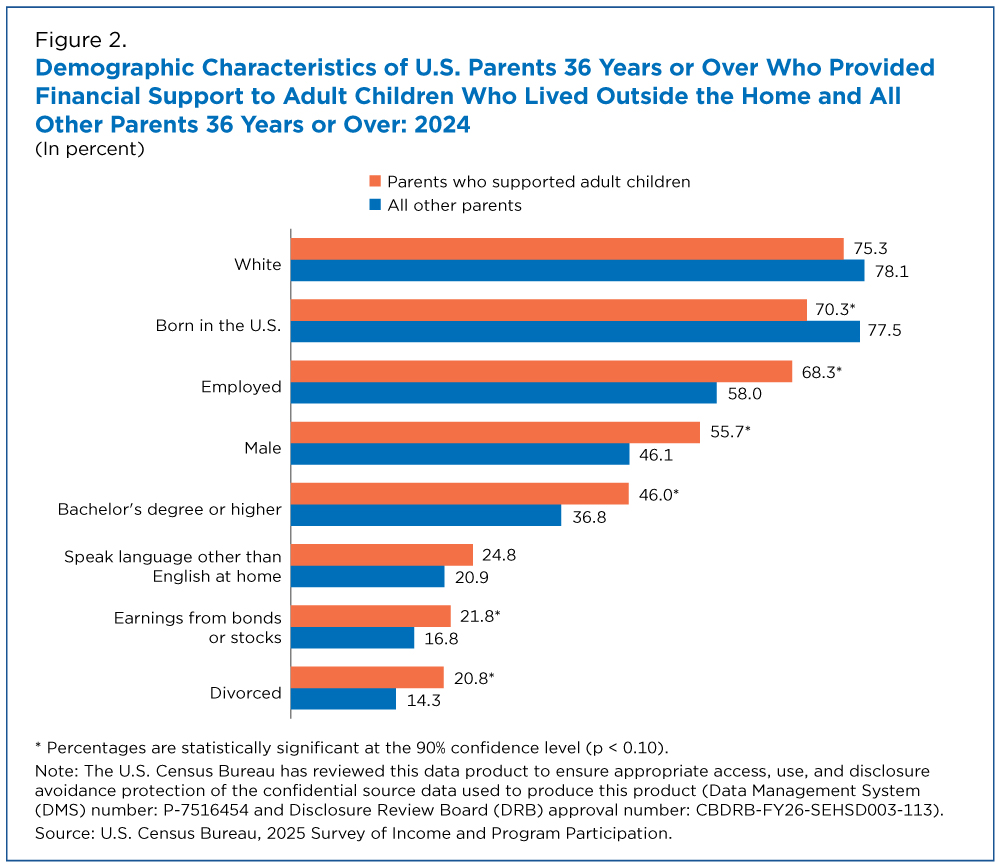
The givers also earned more themselves. Their median personal income was $63,440, compared with $41,930 for other parents. Their median household income was $110,700, against $98,110 for other parents, but the bureau said that gap was not statistically significant. Parents who did not support an adult child were more likely to live in households of three or more people (48.3 percent vs. 31.3 percent), which the bureau said might explain why their household incomes were similar.
Pew Research Center, surveying a broader group, found the same pattern of ongoing help. In a January 2024 report, 59 percent of parents with a child ages 18 to 34 said they had helped that child financially in the past year, and only 45 percent of young adults in that age range said they were completely financially independent from their parents. Pew counted help to children at home as well as those living elsewhere, so its figures are not directly comparable with the Census estimates. Pew also found 57 percent of 18- to 24-year-olds lived in a parent's home.
Adult children are the largest recipients
Counting everyone who sends money to someone outside their household, about 11.4 million people gave $78.1 billion to 19.0 million recipients in 2024. Adult children received the largest share, about a third of the total.
| Recipients | People supported | Amount given |
|---|---|---|
| Adult children | 3.7 million | $26.6 billion |
| Other relatives | 5.8 million | $22.8 billion |
| Parents | 7.2 million | $20.2 billion |
| Nonrelatives | 2.4 million | $8.4 billion |
Parents were the most common recipients by head count, at 7.2 million, though they received less money in total than adult children. Nearly two-thirds of the people giving support (64.6 percent) gave to either a parent or an adult child.
For comparison with what households earn, see median household income by state.
Sources
Figures on support to adult children, other recipients, and the characteristics of parents who give are from the U.S. Census Bureau's America Counts story U.S. Parents Gave $26.6 Billion to Their Adult Children in 2024 by Liza C. Valle (September 30, 2026), based on the 2014 to 2025 Survey of Income and Program Participation. Dollar amounts in the 2014 to 2024 series are in 2024 dollars. Survey findings on parents of young adults are from Pew Research Center's Parents, Young Adult Children and the Transition to Adulthood (January 25, 2024). The average per parent is calculated from the Census totals.
Add CensusEasy as a preferred source on Google to see our stories first.
 GENERAL
Black household income rises 76% since 1967, but dollar gap with White households widens
Census figures back to 1967 show Black median household income up 76.2 percent after inflation, to $59,980. The ratio to non-Hispanic White income narrowed, but the gap in dollars grew to $36,730.
 GENERAL
These U.S. counties have the highest housing vacancy rates, but they're not abandoned
Sixty-one percent of housing in Summit County, Colorado is vacant. That's Breckenridge, not a ghost town. Every county at the top of the vacancy list is a vacation destination.
 GENERAL
The area codes with the most people
Hawaii's 808 is the most populous area code covering a whole state, with 1.43 million residents. Arizona averages 1.5 million people per code. Here is every state's area codes and residents per code.
How much do parents give their adult children?
Among parents who financially supported a child 21 or older living outside their home, the median amount given in 2024 was $4,725, according to the Census Bureau. In total, 2.6 million parents gave $26.6 billion to 3.7 million adult children.
Who is most likely to financially support adult children?
Compared with other parents 36 and older, parents who supported an adult child living elsewhere were more likely to be men, employed, divorced, college educated, and earning income from stocks or bonds. Their median personal income was $63,440, versus $41,930 for other parents.
Has parental support to adult children gone up or down?
In 2024 dollars, it peaked at $36.1 billion in 2017, fell to $20.8 billion in 2020, and was $26.6 billion in 2024, compared with $25.3 billion in 2023. The bureau notes that year-to-year swings are expected because the support is informal.